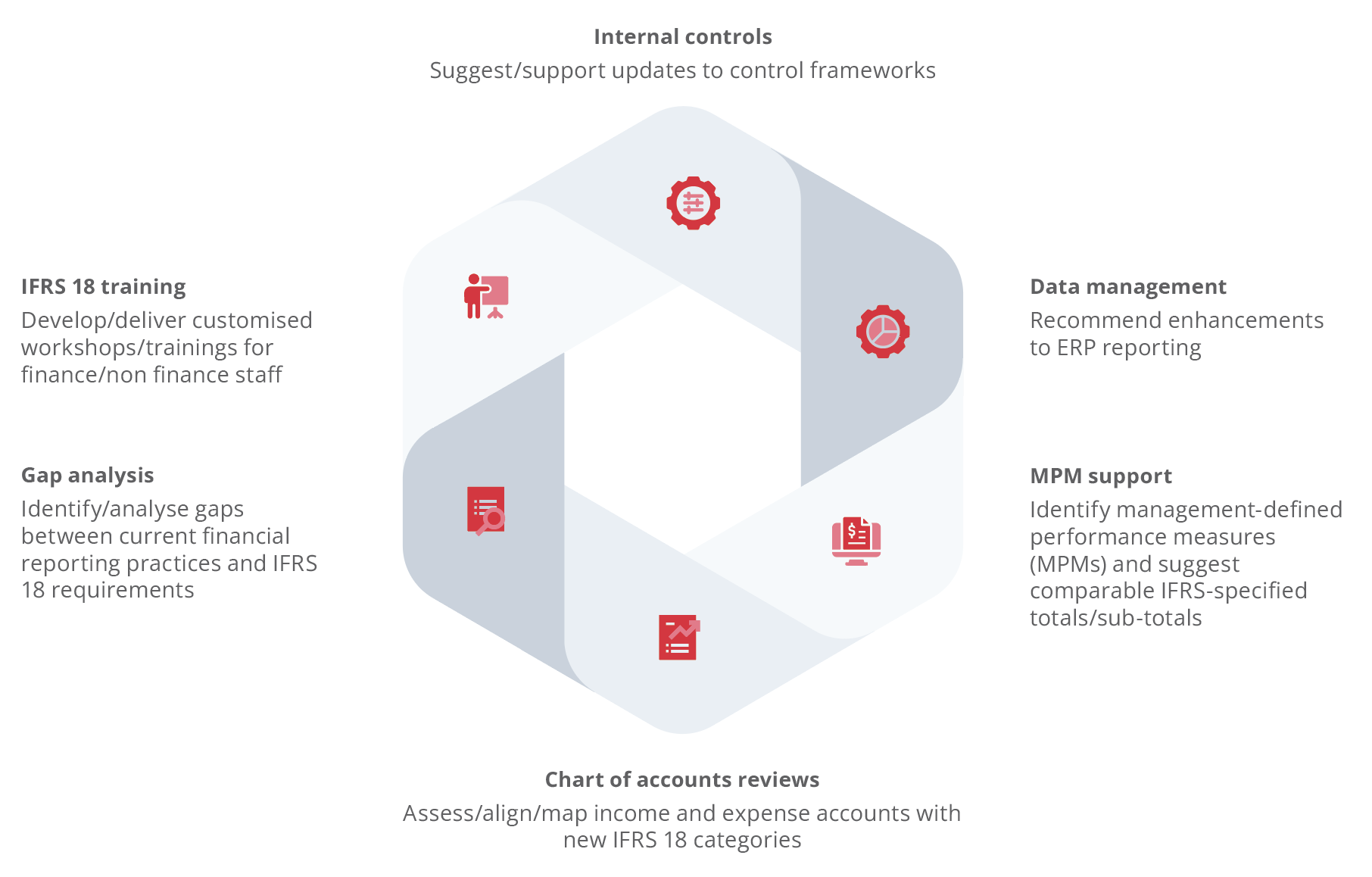






Issued in April 2024, IFRS 18 – Presentation and disclosure in financial statements specifies how information must be set out in financial statements and supersedes IAS 1 – Presentation of financial statements. IFRS 18 impacts all entities preparing financial statements in accordance with international financial reporting standards (IFRS). Designed to increase consistency and transparency in financial performance reporting with a significant focus on an entity’s statement of profit or loss, the implications of IFRS 18 extend well beyond the presentation of data. Key decision makers must also assess its impact on ERP systems, charts of accounts, management-defined performance measures and related internal controls.
To be applied retrospectively, IFRS 18 is effective for annual reporting periods beginning on or after 1 January 2027, with early application permitted. Similar presentation and disclosure adjustments are required for the comparative information as well.
Key updates
Key updates include changes to how information in the statement of profit or loss is presented; additional guidance on investing and financing activities; disclosures about management-defined performance measures; and enhanced guidance on how to aggregate and disaggregate information.
Presentation of statements of profit or loss
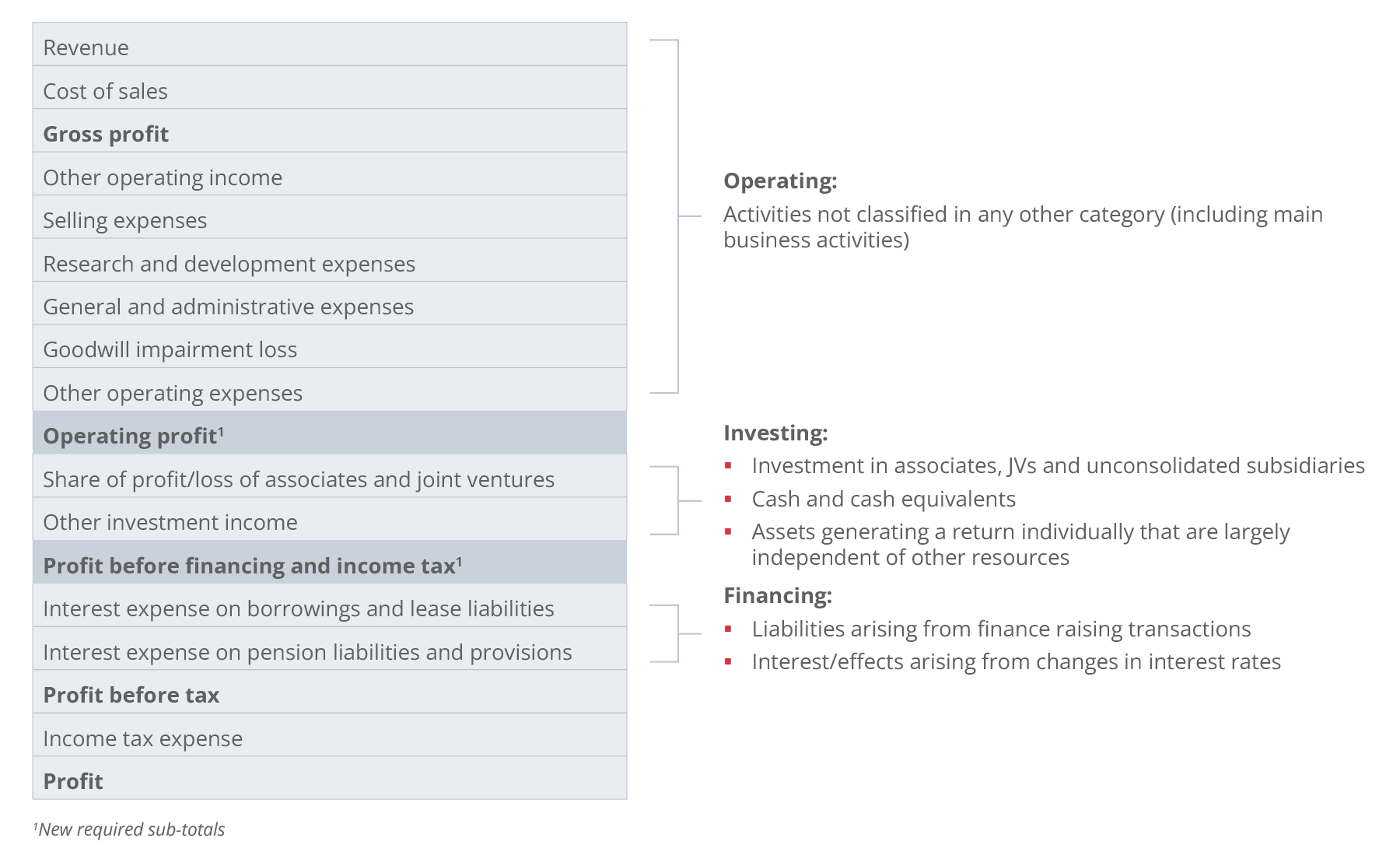
IFRS 18 requires that income and expenses included in an entity’s statement of profit or loss should be classified as related to operating, investing, financing (three new categories), income taxes or discontinued operations, as well as present two new sub-totals as shown in the example:
Additional guidance
The standard provides additional guidance with respect to the categorisation of income and expense when an entity has a specified main business activity of:
-
- Investing in particular types of assets, referred to hereafter as investing in assets
- Providing financing to customers
Subject to the requirements of the standard being met, an entity with a specified main business activity classifies in the operating category some income and expenses that would have been classified in the investing or financing category if the activity were not a main business activity.
Management-defined performance measures (MPMs)
Organisations often provide their own metrics of performance in financial communications, such as adjusted profit/loss, operating profit, or EBITDA. To external stakeholders, it may be unclear why these metrics have been adjusted or used or how they were calculated. Equally, these metrics may be published outside of the financial statements and hence outside the scope of an assurance process. In response, IFRS 18 requires disclosures of MPMs where used in public communications outside the financial statements and provides for reconciliation between MPMs and the most comparable totals or subtotals specified by IFRS 18 or another IFR standard.
Aggregation and disaggregation of information
Responding to concerns that information in financial statements was not always aggregated or disaggregated appropriately, IFRS 18 sets out the principles for aggregation – adding together of assets, liabilities, equity, income, expenses or cash flows based on shared characteristics and are included in the same classification; and disaggregation – the separation of an item into component parts that have characteristics that are not shared – of items in the financial statements.
Under IFRS 18, entities are expected to:
- Classify/aggregate assets, liabilities, equity, income, expenses or cash flows into items based on shared characteristics
- Disaggregate items based on characteristics that are not shared
- Aggregate/disaggregate to present the line items in a way that provides useful, structured summaries
- Aggregate/disaggregate to disclose the information in the notes in a way that provides material information
- Ensure that aggregation/disaggregation does not obscure material information
How can Keypoint support IFRS 18 transition?
With IFRS 18 becoming effective on or after 1 January 2027, finance executives should be assessing implementation readiness, including changes required to data capture, account mapping, charts of accounts, reporting processes and disclosures.